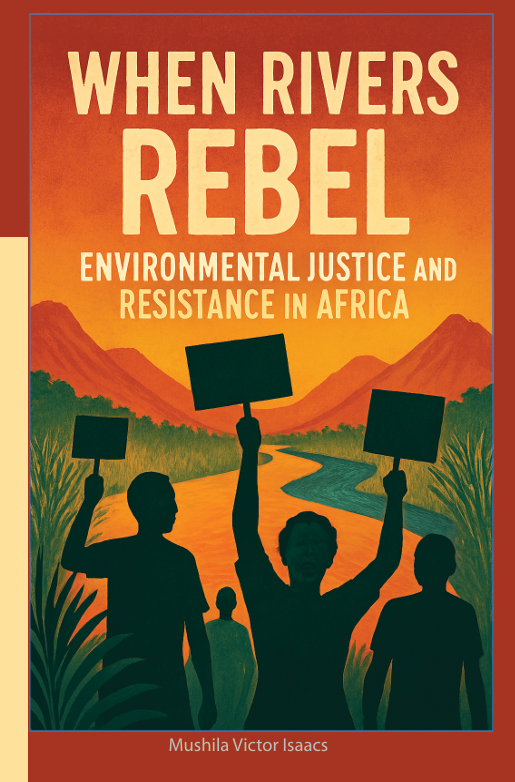
“When the river speaks, it is not just water that flows, but memory, resistance, and prophecy.”
Rivers are the oldest historians of the African continent. Long before the boundaries drawn by colonizers, long before flags and constitutions and multinational investments, the rivers knew. They knew the movement of peoples, the rise of empires, the cadence of ceremonies, and the wisdom carried in ancestral chants. The Nile, the Congo, the Niger, the Zambezi, and the Tana are not just arteries of water—they are sentient witnesses of time, resistance, and renewal.
The Nile, longest and most storied, carried the dreams and cosmologies of ancient Nubia and Egypt. It was not merely a water source; it was a deity, a calendar, and a covenant. Its floods signaled life, fertility, and harmony with nature. The pharaohs built temples in its honor. Farmers sowed in anticipation of its rhythm. But in the postcolonial present, the Nile has become a site of tension. Ethiopia’s Grand Renaissance Dam is hailed as a beacon of sovereignty by some and feared as a threat by others. Egypt, whose legal and political narratives around the Nile still echo colonial water rights, finds itself in conflict with upstream nations asserting new claims. In this, the Nile is not just water—it is a record of power, still contested.
The Congo River pulses through one of the world’s most biologically rich regions and one of its most wounded. It flows through the heart of Central Africa, carving its path through rainforest and red soil, and through centuries of suffering. The colonial brutality of King Leopold’s regime turned the Congo River into a conveyor belt for extractive violence. Millions died, their lives and labor swallowed by the thirst of European greed. The river absorbed it all—the blood, the cries, the stolen wealth. Today, its banks are dotted with mining sites and conflict zones, and its depths mirror the unhealed wounds of exploitation. But the river also carries hope. Grassroots movements, Indigenous leaders, and young activists are rising, defending the rainforest with the same resilience that once birthed anti-colonial resistance.
The Niger River winds like a sacred serpent through West Africa. It nourished the golden ages of Ghana, Mali, and Songhai, empires whose economies and scholarship left global footprints. Along its waters, griots recited epics, and traders exchanged salt, gold, and stories. But the Niger is not only historic—it is mystical. In its currents dwell spirits like Mami Wata, revered across West Africa as protectors and judges. That spiritual bond was tested—and desecrated—when oil replaced water as the region’s treasure. In the Niger Delta, drilling has poisoned rivers, killed fish, and displaced communities. The resistance, however, has been fierce. Led by voices like Ken Saro-Wiwa, the Ogoni people reminded the world that environmental justice is not optional—it is survival.
To the south, the Zambezi River crashes and chants its way toward the Indian Ocean. At Victoria Falls, it becomes Mosi-oa-Tunya, 'The Smoke That Thunders'—a site of power and reverence for the Lozi and other local peoples. Colonial explorers, traders, and missionaries misread the Zambezi as a highway of profit, mapping it for exploitation. The Kariba Dam, a supposed marvel of modern development, displaced over 50,000 Tonga people, burying not just homes, but histories. Today, new dam projects risk repeating the same mistakes. But resistance is mounting. Communities are reclaiming ancestral knowledge, advocating for reparative policies, and challenging the logic that equates development with dispossession.
In Kenya, the Tana River flows from the snowcaps of Mount Kenya to the Indian Ocean, sustaining millions through irrigation, fisheries, and hydroelectric power. But beneath its nurturing surface lies a troubled past—and present. For decades, state-led development schemes have encroached upon the rights of Indigenous groups like the Pokomo and Orma. Dams, plantations, and land grabs have prioritized profit over people. Climate change, with its erratic floods and withering droughts, has only sharpened the injustice. Yet the Tana has not fallen silent. In courtrooms, in villages, and on digital platforms, communities are pushing back. They are recording oral histories, organizing legal challenges, and producing documentaries like Whispers of the River, which amplifies riverine voices that refuse to disappear.
Africa’s rivers are not passive landscapes. They are political beings—resisting privatization, defying extraction, and demanding recognition. Colonial and postcolonial governments have long treated rivers as lifeless resources, to be owned, dammed, redirected, or sold. But Indigenous cosmologies tell a different story: rivers are relatives, not commodities. They possess spirit, memory, and agency. Across the continent, this perspective is finding legal expression through the Rights of Nature movement. Rivers, under this framework, could be granted legal personhood—recognized in law as entities with rights to flow, to be clean, to exist. It is a profound shift, one rooted in Indigenous worldviews and backed by environmental law.
As the climate crisis deepens, rivers are reaching breaking points. They are flooding unpredictably, drying beyond recovery, and retreating into silence. But this silence is not consent. It is a scream. Every poisoned water source, every dam-induced displacement, every extinguished species—these are the river’s protests. In their rebellion, they are asking us to choose: exploitation or kinship, short-term gain or generational justice.
The rivers remember everything. They remember the enslaved bodies dumped during colonial conquests. They remember the freedom songs sung in hidden valleys. They remember the treaties ignored, the warnings dismissed, the children who played along their banks and never returned. To listen to the rivers is to reconnect with the truth of this land. To protect them is to defend the future of Africa itself.
The rivers are speaking again.
We must learn to listen.
Diplomatic institutions have an especially important role to play in this transformation. International agreements addressing climate change and sustainable development should explicitly recognise postcolonial water justice and the unequal burdens carried by communities whose rivers have been exploited for centuries. Embassies, development agencies, and multilateral organisations should create permanent forums where African youth activists, indigenous leaders, scientists, artists, and community representatives participate not as symbolic guests but as equal architects of future environmental policy.
Continental institutions likewise face an historic responsibility. Africa's shared water frameworks must evolve beyond voluntary aspirations into stronger commitments that encourage cooperation, ecological restoration, and equitable governance across river basins. Rivers ignore colonial borders; therefore, policies protecting them must increasingly reflect ecological realities rather than inherited political divisions. Cooperation among neighbouring states should be measured not only through economic integration but also through the health of the waters they share.
Academic institutions are equally challenged by the demands of the river. Environmental scholarship can no longer rely exclusively upon imported theories while overlooking the sophisticated ecological knowledge preserved within African communities. Universities should embrace decolonial approaches that integrate indigenous hydrology, oral traditions, river cosmologies, customary water governance, and community-based environmental monitoring alongside contemporary scientific research. Knowledge grows strongest when multiple ways of knowing are allowed to flow together.
Collaborative publishing between universities and grassroots organisations should become the norm rather than the exception. Research findings ought to be translated into African languages, shared through community workshops, radio programmes, digital platforms, and schools, ensuring that knowledge returns to the communities from which much of it originates. Climate research should increasingly prioritise African leadership, African institutions, and African questions rather than treating the continent merely as a site of external investigation.
Environmental organisations must also examine their own practices critically. Conservation cannot be separated from questions of justice, land rights, cultural survival, and historical accountability. Too often, communities have experienced displacement in the name of protecting biodiversity, creating new forms of ecological injustice through so-called green development. Genuine restoration requires approaches that strengthen both ecosystems and the communities who have protected them across generations.
Watershed-based governance offers one practical path forward. Local communities should participate directly in protecting and managing the rivers upon which their livelihoods depend. Community-elected watershed councils can monitor pollution, restore wetlands, coordinate conservation activities, document indigenous ecological knowledge, and work alongside scientific institutions to strengthen basin-wide resilience. Such governance is no longer an unrealistic aspiration; it has become an ecological necessity.
African youth deserve central leadership within this transformation. Their creativity, technological innovation, artistic expression, environmental organising, and political imagination represent some of the continent's greatest strengths. Continental youth assemblies focused on river justice could produce declarations, artistic collaborations, scientific initiatives, legal proposals, and policy recommendations that challenge outdated systems while inspiring new generations to become guardians of Africa's waters.
The restoration funds advocated throughout this book should therefore flow directly toward communities protecting rivers rather than disappearing within distant administrative structures. Community-controlled trust funds can support wetland restoration, indigenous tree planting, water quality monitoring, ecological education, women's leadership programmes, youth innovation, sustainable livelihoods, and legal advocacy protecting rivers from destructive development. Restoration succeeds most effectively when local communities remain its primary decision-makers rather than its passive beneficiaries.