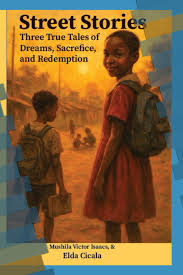
Before the sun even thinks of rising over Westlands, Deepsea is already awake. Not in a poetic way, but in that stubborn, chaotic way only a forgotten slum can be. Roosters compete with the rumbling of early morning boda bodas, pots clang, children cry, mothers shout instructions half-asleep, and from the narrow alleys comes the unmistakable smell of charcoal smoke and last night‘s rain trying its very best to dry.
Deepsea is squeezed into a corner of Nairobi like a secret no one wants to admit is real. Tourists pass through Westlands with cameras swinging on their necks, talking about cafés, malls, and nightlife, never imagining that just a few steps away lies a place where roofs are made of rusty iron sheets held down by stones, and where hope must be held tightly or it slips away like morning mist.
In this vibrating world of noise and struggle, Grace is already awake.
Grace Wanjiru, the woman everyone simply calls Mama Grace, moves quietly inside her tiny one room home. The room is so small that when she stretches her arms, she can almost touch both walls. An old metalic bed leans against one side, and three old plastic chairs that look like they have retired from active service sit patiently beside a wooden table which wobbles as if it is tired of holding anything.
But still, Grace manages.
She always manages.
Her morning begins with boiling water on a black charcoal cooking stove commonly known as jiko. The jiko coughs like an old man as she fans it, muttering something about charcoal that refuses to catch fire. She laughs at herself softly, because in Deepsea, even laughing must be economical to save strength for the day.
Outside, the alley is coming alive.
A neighbour calls out, ―Habari ya asubuhi,‖ which means ―Good morning.‖ The greeting floats through the air like music, and Grace responds warmly.
Everyone in this place knows her.
Some call her teacher, others call her mother, and some simply refer to her as that woman whose heart is bigger than Deepsea itself.
She steps outside with her basin, ready to fetch water. She walks carefully along the narrow path, balancing the basin like a dancer. Children run past her chasing a plastic bottle tied to a string, pretending it is a car, shouting ―Gari imefika,‖ which means ―The car has arrived.‖
Grace laughs again, shaking her head.
In Deepsea, imagination does the work of money.
At the communal tap—whose water supply is graciously sponsored by the Consolata Shrine Catholic Church—Grace lets out a quiet sigh. The queue is already snaking far behind her.
Some people need water for laundry, others for bathing, and others for reasons too many to list; the line is always long.
A woman in front grumbles that the water pressure is slower than Nairobi traffic on a Monday morning. Another chimes in, joking that they should start charging the tap rent since it behaves like a troublesome tenant who only works when it wants.
Grace offers a polite smile but stays silent.
She knows too well that complaints don‘t make the water run any faster.
In places like this, even a simple trickle of water could spark a quarrel—if the world ever fights a Third World War, she thinks, it might just start at a water point.
Once she fills her basin, she carries it home with surprising strength for someone who barely eats enough.
Back at the house, she washes her face, ties a scarf around her head, and prepares for the next part of her morning.
She opens her tiny kiosk, the one squeezed between two houses like a stubborn weed that refuses to die. Tomatoes, sukuma wiki which means collard greens, onions, and a few potatoes are arranged on an old wooden crate.
She wipes them lovingly, as if they were precious jewels.
To her, they are.
This kiosk feeds her children. It pays school fees when God is in a generous mood. It keeps her going.
Customers trickle in one by one.
A man buys two tomatoes on credit and promises to pay tomorrow. Grace pretends to believe him.
Two primary school girls stop to greet her. One of them, barefoot and grinning, asks if she can sit for a moment.
Grace nods.
Soon the girl is telling a dramatic story about how a chicken chased her all the way to school. The chicken in her story is the size of an ostrich, breathes fire, and has political ambitions.
Grace laughs so hard that she has to hold her stomach.
These moments push her through the day.
The stories, the noise, the laughter, the tears, the children who treat her kiosk like a safe corner of the world.
What no one sees is how tired she really is.
Deep inside her, exhaustion sits like a silent companion. She sleeps four hours a night. She carries burdens that would break a stronger person.
But her face rarely shows it.
Her heart knows weakness is a luxury she cannot afford.
As midmorning approaches, Deepsea grows hotter, the sun pressing down until the iron-sheet roofs absorb heat like angry frying pans.
Above, vultures circle lazily, waiting for whatever the day might offer. Dogs bark at every passerby carrying a sack—years of living in the slum have taught them that sacks often hide food scraps or trash worth fighting for, so they chase the scent before the chance slips away.
But Grace keeps working.
She serves customers, checks on her children, and gathers together the scattered pieces of a life that has been broken and rebuilt more times than she can count.
A small boy approaches shyly, dust caked on his feet.
In a soft, timid voice, he asks if Grace has any leftovers he can eat.
She leads him inside, scoops a little unga—maize flour—from her small ration, and cooks a thin porridge for him.
The boy slurps it eagerly, his smile so full of gratitude it seems to brighten the entire room.
Grace watches him quietly.
In her eyes burns a gentle light—the kind found only in people who have suffered deeply yet still choose kindness, again and again, every single day.
Deepsea may be a slum no one sees, but Grace sees everything.
She sees hunger behind playful eyes.
She sees fear hidden in forced smiles.
She sees dreams trying to grow in soil that refuses to soften.
And she sees her own purpose rising every morning like the stubborn sun.
Mama Grace, quiet yet unshakeable, moves through Deepsea with the calm determination of someone who refuses to be defeated by circumstance.
She lives in a makeshift homestead where a line of open sewage passes right by her door. The neighboring shack is so close that anyone could peep through the thin, patched-up walls to see what is happening inside.
From surrounding rooms come constant noises—whispers, arguments, laughter, and the murmur of people trading whatever they must, legal or not, in order to survive another day.
Grace is not loud.
She is not rich.
She is not famous.
She does not chase attention or validation.
Yet in this forgotten corner of Nairobi, she is everything—a mother, a guide, a healer, a silent hero.
And as the day stretches ahead, deep inside this woman who owns almost nothing, grows a strength that will one day transform countless lives.
Deepsea may be the slum no one sees.
But through Grace, it is about to be seen.