The wind howled across the arid plains of northern Kenya, where red dust swirled like whispers of forgotten names. Along the invisible line separating nations that once symbolized safety from despair, children trudged behind weary mothers, their limbs fragile from hunger, their eyes hardened by too much reality too soon. No border post greeted them, no sign announced their arrival into a place of refuge. Only the horizon stretched endlessly, indifferent and open, like the road ahead.
This road without borders is more than just a physical trail; it is a haunting metaphor for the stateless condition that defines the lives of millions who walk with nowhere to return and nowhere to arrive. These are not journeys inspired by curiosity or wanderlust, but forced exoduses, desperate and unchosen. The paths stretch across deserts, rivers, forests, and memory, leaving behind scorched homes and lost loved ones. And in these footsteps lie stories that rarely reach the headlines, but cry out with equal urgency for remembrance, justice, and human dignity.
In the silent spaces between checkpoints and bureaucratic indifference, the magnitude of displacement reveals itself. In 2024 alone, more than four and a half million people in East Africa were forcibly uprooted from their homes. Behind this statistic are the silenced symphonies of grandmothers left behind, lullabies no longer sung, classrooms abandoned, and laughter frozen in fear. Yet in the language of international policy and diplomacy, these lives are often translated into codes: refugee, migrant, IDP. The poetry of their being is lost in the categorization.
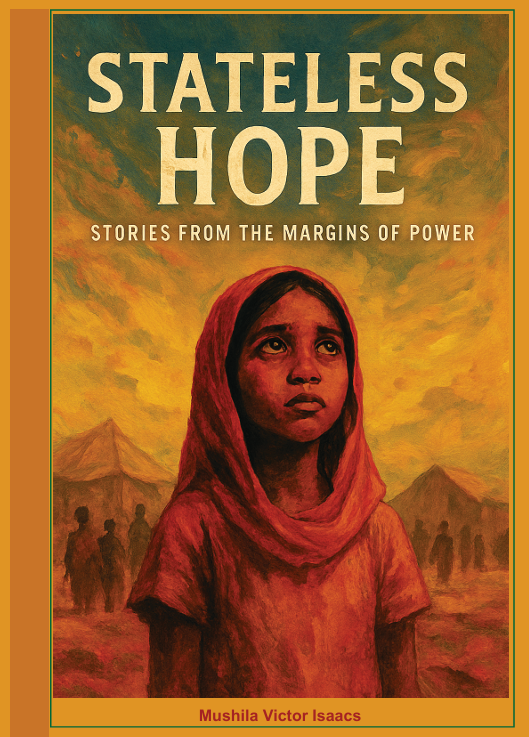
In the town of Pagak, close to the South Sudan-Ethiopia border, the sun had just begun to rise when Mariam whispered a final goodbye to the smoldering ruins of her village. Militiamen had stormed through before dawn, their torches flaming, their machetes thirsty for blood. Her husband did not survive. Her five children did, their tiny feet blistered from escape, their voices silenced by trauma. Mariam did not know where the road led, only that she had to follow it. “There were no signs,” she recalled at Kakuma Refugee Camp. “Only footprints in the sand and prayers in my heart.”
Across East Africa, similar stories echo from village to village, crossing rivers that separate countries but not pain. Children walk for days, some without food, others carrying siblings on their backs. Some vanish into forests and riverbanks, their names never spoken again. The few who make it to camps often arrive hollowed out by the weight of survival.
For the displaced, borders are not lines on a map. They are walls without compassion, designed more to exclude than to protect. In towns like Moyale, straddling the Kenyan-Ethiopian boundary, refugees flee gunfire only to face suspicion and bureaucracy. Documents are demanded from those who escaped without time to gather shoes. In Uganda’s southwestern border, those who flee the eastern DRC find temporary safety, but live suspended in time—neither at home nor fully welcome. In Tanzania, remnants of past genocides still echo as Rwandan exiles remain in a state of legal ambiguity, neither here nor there.
The process of becoming recognized is painfully slow. In Nairobi, a legal aid agency working with refugees reports that over sixty percent of asylum seekers wait over eighteen months for documentation. In that limbo, they cannot legally work, enroll children in school, or access anything beyond the barest minimum of healthcare. The dignity of dreams is replaced with the dull ache of waiting.
Ali, once a history teacher in Kismayo, now sells charcoal by the roadside near Dadaab. His palms are blackened by soot, but his memory remains sharp. “I taught the rise and fall of empires,” he says with a bitter smile. “Now, I’ve become part of the forgotten chapters.” In the narrative of survival, many like Ali are forced to barter knowledge for food, dignity for necessity.
The erasure of childhood is one of the cruelest consequences of forced migration. In the soft murmur of the night, children once sang lullabies. Now, they listen for gunfire. A boy who should be kicking a football in Juba is instead carrying a jerrycan of water for kilometers. A girl who should be learning arithmetic in Goma instead crouches in a tent, shielding her younger sibling. They are displaced not only from place but from time. Their innocence is a casualty never reported.
At a safe space near Kakuma, supported by UNICEF, a mural adorns a crumbling wall: children with radiant smiles fly kites across green fields. Beneath the artwork, the real children sit cross-legged, drawing scenes from homes they barely remember. With stubby charcoal sticks on pieces of cardboard, they sketch huts, cattle, rivers—and silence. Here, the act of drawing becomes therapy. They do not speak of war. Their silence says more.
Some children arrive alone, separated during midnight stampedes or gunfire. Others arrive with no one left. With no documentation or known relatives, they are declared “Unaccompanied Minors.” But they redefine themselves through community. “We are not alone,” they say. “We are more than numbers. We are more than what they call us.”
While much of the focus in humanitarian narratives falls on men with weapons and politicians with microphones, the engine of resilience in the refugee world is female. Women carry babies on their backs and entire communities in their hearts. They feed children with rationed flour, stitch clothes from torn fabrics, and remember stories when all else is lost. In Kalobeyei, a camp settlement, a group of women from South Sudan formed “Mothers Without Maps.” They carry no GPS, but they remember every step of their journey with poetic clarity. They stitch memory into cloth, and recite oral poems at twilight, songs passed down in exile.
One such woman, Nyamal, is forty-six. Her eyes hold both sorrow and fire. She lost three sons during the war. Yet each evening, she sits with younger girls and guides them through storytelling circles. One girl, barely a teenager, speaks of becoming a lawyer, “so that no child will ever again be called illegal.” Another girl, even younger, clutches a stone and says simply, “I want to go home. But I don’t know where home is.”
Conflict drives many of these journeys, but it is not the only force. Nature, once a companion, now turns its back. Droughts ravage northern Kenya and Somalia, driving entire pastoralist communities into new forms of exile. These are the climate refugees—nomads whose rivers no longer flow, whose herds lie rotting, whose skies offer only silence.
In Garissa and Turkana, families that once relied on ancestral rhythms of rain now huddle in plastic tents, their identities torn not by politics but by weather. Climate does not ask for permission. It does not wait for asylum laws to be updated. It creates a new class of the displaced—those who cannot even name their enemy.
The global empathy scale remains tragically unbalanced. Rightly, the world opens its doors to those fleeing bombs in Ukraine. But what of the child whose village in Ituri Province was devoured by warlords? What of the Somali girl whose prayer was interrupted by a drone strike? What of the Congolese grandmother who fled a massacre only to die at a border checkpoint?
A student at a Nairobi university, who arrived stateless from Rwanda and later became a Kenyan citizen, once asked with piercing clarity: “Do we matter only when we die in big numbers? Must our suffering be televised before anyone cares?”
The injustice is not just in unequal treatment, but in unequal imagination. Who are we allowed to see as human? Whose tears do we believe?
Still, the light survives. Amidst this tide of suffering, networks of resilience form. Former refugees who found some stability now help others find their footing. Youth-led initiatives offer mentorship. Faith-based institutions feed strangers and offer shelter. Within camps, laughter still echoes. Football games are played with handmade balls. Women plant vegetables in upcycled containers. Children write poems about the moon.
These moments are more than acts of coping. They are declarations. They say: “We are still here. We still dream. We still resist the slow erasure of our names.”
The road without borders stretches far into the unknown. It is paved with grief, but also with unyielding courage. In every blistered footstep is a story that the world must hear. In every child’s whisper is a declaration that cannot be ignored.
We walk with them not out of pity, but because their story is part of ours. Because borders are not the answer. Because humanity must not be confined by walls, but expanded by empathy.
Because stateless hope is still hope.