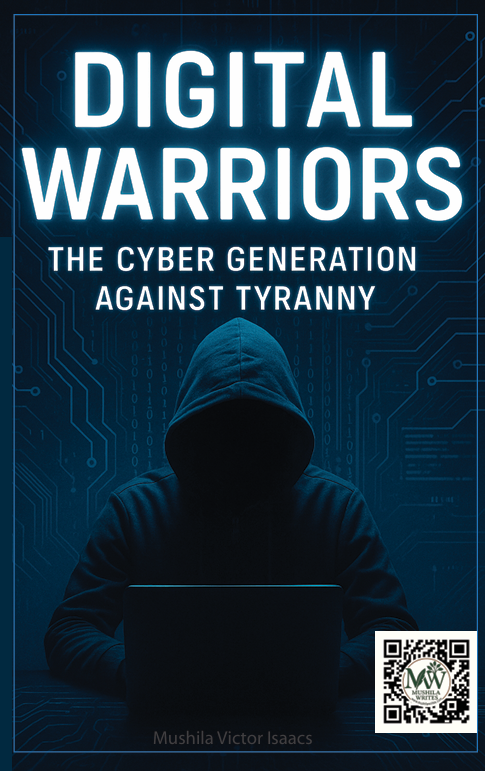
They did not wear uniforms or march in columns. They didn't wave flags or light torches in the night. They did not shout in the streets, at least not at first. Their voices emerged as pings and pulses, digital whispers in invisible corridors of fiber and air. In basements and bedrooms, in libraries and cafés, in exile and in silence, they gathered—not in town halls or public squares, but in chatrooms, encrypted messengers, the deep web, and the blinking, humming pulse of underground servers.
These were not your grandfather's revolutionaries. They were not born from the same wars, trained in the same trenches, or guided by the same ideologies. Instead, they were raised on code, conspiracy, and contradiction. Their earliest rebellions weren't fought with fists but with firewalls, not with knives but with keystrokes. A generation shaped not by monuments and manifestos but by algorithms and memes. And somewhere, between the surveillance of the state and the apathy of the masses, they began to write a new story of resistance. One told not in ink but in binary.
This rebellion began as a flicker—unnoticed, almost ridiculous. A university student in Tehran routing his message through seven proxy servers to post a blog criticizing the government. A teenage girl in Cairo livestreaming police brutality to a Twitter audience of 17 followers. A transgender coder in Manila programming a digital safe house for queer youth. A hacker collective in Belarus quietly unlocking the internal emails of state officials. And a whistleblower in Virginia, packing up state secrets into encrypted folders, unsure if the next sunrise would come with freedom—or arrest. These were the seeds. Scattered. Disconnected. Quiet.
And yet, like sparks in a dry forest, they caught.
Rebellion in the digital age does not explode. It seeps. It leaks through cracks. It floats across borders in the form of images, testimonies, hashtags, and data dumps. It does not declare itself through manifestos stapled to walls but through leaked documents, untraceable signatures, masked identities. Rebellion, once a public spectacle, has become a whisper network—coded, camouflaged, almost poetic in its design. The revolution is not televised. It's livestreamed. Archived. Embedded in QR codes, disguised in memes, cloaked behind VPNs, and hidden in plain sight beneath the surface of the internet.
In this new order, the keyboard is not a tool. It is a weapon. The activist is not only a marcher but also a coder, a cipher, a curator of truth in a sea of distortion. And truth itself? It has become a currency, hunted and hoarded, encrypted and endangered.
Consider Edward Snowden. A man who sat in the heart of a vast surveillance machine and dared to crack it open. Not with bombs or banners, but with files—thousands of them. Documents that revealed just how far states had gone to record, monitor, and control their citizens under the banner of national security. What he released was more than data; it was a mirror. A reflection of how deeply the line between security and tyranny had blurred in the digital age. Through a simple transfer of files, he did what many could only dream of—he pierced the veil. He lifted the mask.
But Snowden is not the only one. In every repressed country, in every censored region, digital warriors are arising. In Iran, anonymous hackers breached the databases of the Ministry of Intelligence, exposing the brutal suppression of protestors. In Myanmar, following the 2021 military coup, activists formed the “Cyber Resistance” movement—flooding military servers with malware, disrupting propaganda channels, and smuggling data to the international press. In Egypt, young coders quietly archived deleted videos of police abuse, creating a ghost library that authorities could not destroy. Their names are often unknown. Their faces, blurred. But their fingerprints are everywhere—in viral tweets, viral videos, in the trails they leave behind on the web.
The new rebel does not seek fame. She seeks freedom.
And yet the digital rebel fights in a paradox. The internet—once hailed as a liberation tool—has become a double-edged sword. For every encrypted message, there is a surveillance algorithm. For every safe platform, there is a backdoor. For every leak, a takedown order. Governments have grown wise. Tyranny, too, has gone digital. It wears the face of spyware, drones, troll farms, and data mining. States no longer need secret police; they have metadata. They don't burn books—they alter search results.
This makes the struggle all the more urgent, and all the more poetic. In this age, truth itself becomes an act of rebellion.
There is something sacred about the act of archiving the truth. When a digital rebel uploads the testimony of a torture survivor to a blockchain platform, they are not simply sharing a story—they are engraving resistance into permanence. Data becomes defiance. Memory becomes immunity. In regimes where history is rewritten overnight, the archive becomes a battlefield. And those who fight to preserve it—cyber librarians, digital archaeologists, information smugglers—are as heroic as any freedom fighter with a rifle.
In Gaza, during internet shutdowns, activists shared footage of bombings through Bluetooth mesh networks. In Nigeria, during the EndSARS protests, youth coders created apps to track police movements in real time, even as authorities banned Twitter. In Hong Kong, masked protestors used AirDrop to share protest maps and meeting points, bypassing online surveillance. In Russia, dissenting journalists installed hidden nodes on the Tor network to leak Kremlin disinformation campaigns. In the U.S., Indigenous cyber warriors documented oil pipeline invasions with drones, uploading footage to decentralized platforms immune to takedown.
Every act of resistance left a trail—a fragment, a trace, a piece of the collective pulse of rebellion.
There is a manifesto, not written in paragraphs but in packets. It doesn't begin with “We the People,” but with lines of anonymized code. Its authors are many—uncredited, unarmed, unyielding. You cannot tear it down because it lives in a million locations. You cannot ban it because it shifts forms. You cannot imprison it because it is not a person—it is a current. A signal. A force.
The rebel in this era wears many skins. She may be a university student quietly translating human rights reports into censored languages. He may be an exile in Berlin, editing videos of atrocities he escaped. They may be a group of 12-year-olds launching TikTok campaigns to crash propaganda hashtags. The battlefield is everywhere. And the war is waged in code, in content, in connection.
But make no mistake: it is a war.
A war for memory. For dignity. For sovereignty. For the right to speak, to dream, to dissent without fear. The digital age has given us extraordinary power—and extraordinary peril. And in this battleground, neutrality is a myth. To choose silence is to side with suppression.
There are those who will argue that digital rebellion is a myth. That it changes nothing. That hashtags are not hammers, that code cannot topple empires. But tell that to the governments who shut down the internet during protests. Tell that to the intelligence agencies scrambling to decrypt whistleblower files. Tell that to the young dissident whose blog became a beacon for thousands, who lives on even after their execution—immortalized in reposts, in archives, in remixes, in memes.
The truth is, code can kill lies. A line of code, strategically written, can disable a server, reveal a crime, erase a surveillance record, or save a life. What the printing press did for revolutions of the past, code does for the revolutions of today.
And so this is not merely a chapter. It is an invitation. To decode. To dissent. To download the truth. To resist the erasure of memory, the algorithmic silencing of speech, the normalization of state control. The internet may be the last true frontier of freedom—or its final grave.
The choice is ours.
As you scan the QR embedded on the final page of this book, remember that it is more than a link. It is a torch. Carried by those before you. Kept burning by those beside you. Waiting to be passed on to those who will come after you.
Because the manifesto is alive.
And it begins every time a rebel writes:
01010011 01110000 01100101 01100001 01101011.
Speak.