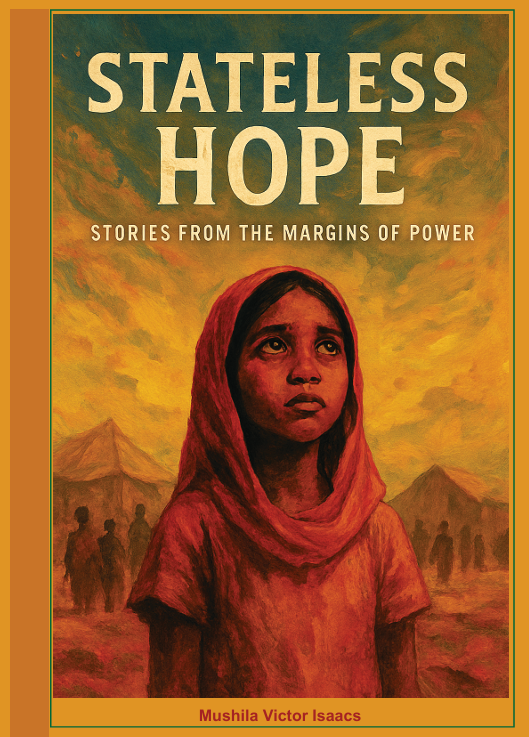
In the dry northern reaches of Kenya, under the expansive skies and near ancient trees that whisper in the wind, lives a young woman named Fatuma. She is twenty-seven years old. Her skin is kissed by the sun, her voice carries the rhythm of Kiswahili, and her life is stitched into the red dust of the land where she was born. Yet, on paper, she does not exist. Born in a refugee settlement to Somali parents who had long escaped the chaos of their homeland, Fatuma has never known another place. Kenya is all she has ever seen, smelled, and touched. It is her motherland, by spirit if not by law. But the state does not know her. She has no identification, no passport, and no recognition. Fatuma is not a citizen of Kenya, or of anywhere else. She is stateless.
To be stateless is not only to lack documentation; it is to be denied a name that holds weight in the eyes of the law. It is to live in a country your ancestors helped build and still be seen as alien. According to the United Nations High Commissioner for Refugees (UNHCR), over fifteen million people worldwide are stateless. Their bodies occupy space, but their identities are suspended in a cruel purgatory. They are the unseen. The unheard. The unacknowledged.
Fatuma belongs to a silent multitude. In East Africa, countless communities suffer the same fate. In Kenya, generations of Nubians, brought to the country as soldiers during British colonial rule, remain without formal recognition. Their roots run deep, their contributions vast, but their legal presence shallow. In Uganda, the Banyarwanda—descendants of Rwandese migrants and refugees—still face suspicion and documentation barriers, even after decades of peaceful settlement. These people are born into a vacuum where the state neither claims nor protects them.
Statelessness often begins not with the absence of parents but with the absence of paperwork. When a child is born and there is no official record—no birth certificate, no registration—the state’s silence begins. That silence echoes through schools that deny enrollment, hospitals that deny treatment, and offices that deny employment. Statelessness is a void. It grows with each denied opportunity, each closed door. It is a hunger for recognition.
Fatuma once dreamed of becoming a nurse. She had studied with passion, often reading by torchlight, believing knowledge would lead her to freedom. But when she tried to register for her qualifying exam, the form required a national ID. She left the space blank. Her application was discarded. That same year, she fell ill with tuberculosis. In a government hospital, she waited for treatment while others—those with IDs—were prioritized. She remembers the sterile smell of disinfectant, the distant footsteps of nurses, and the tightening in her chest that came not just from illness, but from invisibility.
“I always thought the law was supposed to protect everyone,” she whispered. “But how can it protect me when it doesn’t even see me?”
Fatuma’s story echoes far beyond Kenya’s borders. Across continents, the stateless suffer in silence. In the Dominican Republic, Dominicans of Haitian descent are regularly stripped of citizenship. In Myanmar, the Rohingya have faced systematic exclusion and violence under the guise of statelessness. In Syria, many Kurds are denied nationality and left without access to services. Though their geographies differ, their pain is universal.
Children suffer the most. One in four stateless individuals is a child, born into a shadowed world. These children inherit not only their parents’ histories but their legal invisibility. Without documentation, a child cannot be enrolled in school, vaccinated, or counted in a census. Without proof of birth, their very existence becomes debatable. In patriarchal systems where citizenship passes through the father, and where fathers are missing or deceased, children—especially girls—are left doubly vulnerable. Statelessness then becomes an intergenerational curse.
In the heart of Kampala, Uganda, a twelve-year-old boy named Paul lives at a church-run youth shelter. His mother, a refugee from Burundi, died during childbirth. His father, a Rwandese mason, passed away when Paul was just five. No government has claimed him. He moves through the world like a question mark. At the shelter, Paul keeps a small folder with all his belongings: a torn photograph of his mother, a crumpled letter to God, and a drawing of a hospital where he hopes to work one day. Paul wants to become a doctor. But the gates of secondary school remain closed to him—no birth certificate, no progress.
“I don’t know where I belong,” Paul wrote in his letter. “My friends say they are Ugandan. I want to be something too. Maybe if I had a country, I could help others. But now, I just wait.”
This waiting is an intimate form of violence. The kind that does not leave visible bruises but erodes dignity daily. Statelessness is not an event; it is a lifetime. A slow denial of potential. A bureaucratic suffocation. And yet, within this pain, seeds of resilience often grow.
Across East Africa, civil society and faith-based networks have become lifelines. In Nairobi’s Eastleigh, imams and pastors have joined hands with grassroots paralegals to help youth like Fatuma navigate the labyrinth of legal identity. These efforts are often fragile, underfunded, and dependent on volunteer goodwill—but they are acts of profound rebellion. They reclaim the right to exist.
In Uganda’s refugee settlements, international organizations collaborate with local councils to offer mobile birth registration clinics. In places where roads disappear in the rain and the only currency is trust, health workers carry clipboards and hope, moving from hut to hut, registering newborns before statelessness takes root.
Faith-based hospitals are offering care without paperwork. Religious leaders are demanding legislative reform. Youth-led digital campaigns are rising, telling stateless stories in the language of dignity rather than pity.
Still, systemic barriers persist. Many stateless people are caught between the fault lines of colonial borders. During independence, boundaries were drawn with ink but no understanding of movement. Entire communities became orphans of nationhood. Others are blocked by nationality laws steeped in discrimination. In some states, children born to a national mother and foreign father are citizens—but reverse the genders, and the child becomes stateless. These laws enshrine inequality.
Efforts to reform them often stall in the heat of nationalist politics. Populist leaders use the stateless as scapegoats, blaming them for insecurity or unemployment. The conversation shifts from justice to suspicion. Belonging becomes a battlefield.
And yet, this battle has global consequences. Statelessness is a direct barrier to the world’s shared goals. How do we achieve universal education, healthcare, or legal justice when millions of people cannot even prove they exist? The Sustainable Development Goals promise equity and dignity. Statelessness is a gaping hole in that promise.
Fatuma’s hunger is not for food but for recognition. Paul’s prayer is not for wealth but for belonging. These desires are not abstract. They are fundamental.
What, then, is the way forward?
It begins with listening. With letting stateless people tell their own stories. With acknowledging that the problem is not their failure to belong, but the state’s failure to recognize. Legal reform is essential—laws must be rewritten to protect, not exclude. Birth registration must be universal, mobile, and digitized. Regional treaties must emerge, outlining clear protections. Governments must partner with communities, not police them.
Ultimately, this is a human struggle—not a technical one. The question of nationality is not just legal. It is existential. And every human being has the right to exist with dignity.
Fatuma now works at a local health clinic, as a volunteer. She is still undocumented. Still waiting. But she trains younger girls in hygiene and basic first aid. She walks with her head high. She may not have papers, but she has presence.
“Maybe one day,” she says, “they will give me a card. But even without it, I am someone. I know my name.”
She smiles then—softly, like someone who refuses to disappear.
And that smile is a revolution.